Thursday, July 14, 2011

Scary Movie Update


Check out The Silent House!


Plot:

The plot is based on a true story that happened in the late 40's in a small village in Uruguay. The film focuses on Laura, who, second by second, intends to leave a house which hides an obscure secret, unharmed. Laura and her father Wilson settle down in a cottage they have to renew since its owner will soon put the house up for sale. They will spend the night there and repair the following morning. Everything seems to go smoothly until Laura hears a sound that comes from outside and gets louder and louder on the upper floor of the house. Wilson goes up to see what is going on while she remains downstairs on her own, waiting for her father to come down.


We learn the house knows all your secrets and nightmares. True Story!? Can't wait to see it. I guess it was already released in 2010 where I'm at, but it'll be released soon in the states because it made such an impact.

Again:

The plot is based on a true story that occurred in the 1940s in a small village in Uruguay. La casa muda focuses on the last seventy eight minutes, second by second, as Laura tries to leave the house unharmed and discovers the dark secret it hides.


Like Hitchcock's film Rope, this movie is one, long, sinuous shot, which makes it all the more intriguing.

La casa muda was shot in real time in one continuous 78 minute take, with no cuts. It is one of only a handful of theatrically released movies to be shot in one continuous long take, and it has been billed as the first ever single-take horror film, though this claim is the subject of some dispute.


A film called Infection (2005) might have beat it to the punch. Either way, can't wait to see this!

Sunday, July 10, 2011

Open Your Eyes . . .


David: My dreams are a cruel joke. They taunt me. Even in my dreams I'm an idiot... who knows he's about to wake up to reality. If I could only avoid sleep. But I can't. I try to tell myself what to dream. I try to dream that I am flying. Something free. It never works...


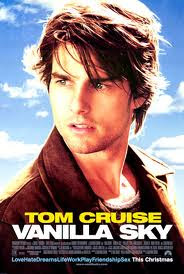
I consider Vanilla Sky to be one of my favorite movies. In the beginning we are flying over various parts of New York City like a spirit from another world. Then we zero in on the flat of David Aames asleep. ‘Sabrina’ with Audrey Hepburn plays on his disappearing television symbolizing the dream of romance. His alarm clock is a recording of Sophia saying ‘Open Your Eyes’. The cover of Bob Dylan’s Freewheelin’ is seen in the background. The point is that we are beginning to see his world, what makes him who he is. He plucks a couple gray hairs, another symbol for the desire to live forever. David is off to work. Yet something is not right. There is not a soul in the busiest part of the busiest city in the world. As he gets out of his car, and he is running furiously through Time Square, every advertisement that flashes before his eyes seeks to be a cure for his loneliness. They are all band-aid solutions that don’t really solve the problem of the human condition in the long run.

But alas it is all a dream. We are disoriented. We now know that this movie is meant to disorient us, so we don’t know what is real and what is a dream. We now know that a dream about being in the most populated city in the world alone is a dream that perhaps a lonely person would have. This is the point where we realize that this isn’t going to be a simple, linear story. The structure of the movie is a flashback from a dialogue between a masked David and court psychologist Dr. McCabe (Kurt Russell) in a holding cell (almost a symbol for the inside of a trapped mind) trying to get to the bottom of why David was sentenced to a mental institution and why he was accused of murdering the love of his life. But it is also David telling Dr. McCabe his autobiography, the story of his life, how he became the man that he is, and how Dr. McCabe becomes the father figure he never had. We can even view glimpses of scenes from To Kill a Mockingbird (in which the motif of fatherhood is on view) in the room where the security guard is on post.

We discover Julie Gianne (Cameron Diaz) with whom he has casual sex, even though she secretly is in love with him. David is a man who has it all and yet is missing something. They are pretending to be in love. Jason Lee plays Brian Shelby, David’s best friend, who has a love for Julie, Radiohead, and has little pearls about life, the bitter and the sweet. He is a loyal friend and a talented writer, which David willingly funds and supports. I sense a nod toward similarities between Brian and Cameron Crowe himself. As David arrives to work at a Manhattan high-rise, we learn that he has 51% control of the company, while 49% belongs to the envious ‘Seven Dwarves’. David believes he was set up by the Dwarves for the murder of Sophia in order to gain control of the company. David’s father was a lover of adventure, but David feels like he let his father down, since he had do deal with petty issues like a fear of heights. Now he is at the reigns of an empire the Dwarves don’t feel he has the courage to lead. He is in the shadow of a father he never really knew and from whom he never got approval or love. David fears the heights that he has by chance reached.

“There are five basic emotions in life, David. Tell me, what emotion gripped him before he entered that cell?”, asks Dr. McCabe. “Was it guilt? Hate? Shame? Revenge?” Pause. Music. “Love?” I must say the editing in the movie was excellent, and I have a newfound respect for movie editors. With my recent fascination with the art of the movie montage, and my own thoughts about how I’d construct one of my own, I’ve paid more attention to the art of editing. Usually, I pay attention to cinematography. The photographic quality of an image, including the actors, background, angles, and lighting, are all fascinating to me. But editing is what juggles all of this artistry around, and weaves all the threads together into an organic whole. For instance, when Dr. McCabe mentions love as the possible reason for David’s descent into madness, there is a gradual close-up, a blurry transition, and then a past scene of David’s birthday party in his penthouse. It is one thing to write this; it is quite another to feel and experience the way the music, images, and dialogue are edited together to create a sinuous emotional element in the viewer. There are many mini-montages like this in the film, giving it more depth, poetry, and power: when David tells Dr. McCabe about his father, during David’s emergence from a coma, his resurrection from a Howard Hughes-like isolation (compared in the movie to the Normandy Invasion), the quick succession of images with a voice-over of all the things in David’s life he found meaningful as he plummets off a skyscraper in a Kierkegaardian leap of faith to awaken from what he now realizes is a lucid dream gone awry, because of his choice to prefer reality to fiction. All of these scenes gather power from the editing.

There are many cries from critics that the movie is a jumbled mess, that Crowe is out of his league and has wondered into unfamiliar, cinematic territory. But based on my own experience of seeing the movie, upon repeated viewings, the movie makes perfect sense. And even if it didn’t, what is wrong with admitting a few irregularities in a movie that admits to being science-fiction and fantasy? All seem to agree about the structure of the movie: the present timeline of David and Dr. McCabe in the holding cell and the past flashbacks. But the confusion begins after Julie crashes her car, sending David into a coma. There is a dream of a reunion with Sophia, but it isn’t yet the lucid dream manufactured by the program “Life Extension”, designed to put people into cryogenic sleep in order to give them a lucid dream in which past pains are erased and the preferred fantasy that the recipient desired comes to pass. But if there are problems, glitches in the program, ‘Tech-support’ is sent into the mind in the form of a person who helps the recipient escape the dream turned nightmare. All of this is the science-fiction portion of the movie, a part I think plays out very well. However, if you follow the sequence of events after he awakens from the coma, when he awakens on the sidewalk to Sophia’s ‘Open Your Eyes’ after he had passed out, the lucid dream sequence has begun, as evidenced by the sky which purposely resembles a Monet painting, since that same Monet painting was an integral part of David’s life and memory. The rest of the irregularities are explained by the glitches within the lucid dream. It’s as simple as that. In reality, when he awakened on the sidewalk, Sophia didn’t help him up, he attempted suicide (as the film explains), fails, and decides to undergo cryonic sleep to erase past hurt and renew a painless fantasy. In the end, though, the fantasy turns into a nightmare and he chooses reality, with the bitter and the sweet, and makes the leap of faith into reality. I would love for someone to explain to me what is so illogical about this plot.

I came away from this movie knowing more about myself, love, and life. The movie is an allegory of the human condition. We are all spiritually asleep and trapped by egoism and hedonism in our own ways. Once or twice in our lives we meet true love and our desire to unite with it is the beginning of our awakening to something real. The movie explored despair in a real and harrowing way. The facial disfigurement added a layer of horror. I especially enjoyed Diaz’s performance as Julie, the saddest girl to ever hold a martini. She is 27, an age where you start to have enough wisdom to know that you’ve blew a few opportunities, that you are passing your prime. There is a despair just beneath the surface of her eyes, especially as their color matches the car she was driving when she drove off the bridge. She is a spurned lover, and though people are quick to attribute her off color remarks about ‘swallowing David’s cum’ to a mental imbalance, I’d ask people to really notice that these aren’t the cries of a confused mind, but a mind thinking very clearly in response to her despairing situation. People are way too quick to attribute, for example, suicide to temporary insanity. I think that is too simple, and doesn’t pay tribute to the complexities of the human psyche as it relates to true despair. Those who say it is because of temporary insanity, I surmise, haven’t gone deep enough into their own despair to know exactly what they’re talking about.

Friday, June 17, 2011

Never Let Me Go

I try and make it a goal to read at least one non-grad school related book a quarter. My thought is this, I am reading so much about something that is so hard to put into words, something that people have spent years trying to articulate, reading some fiction could give a tired mind a break. And, to be honest, reading fiction is much more enjoyable than the new Systematic theology that changes everything or the Church Planting book that really does have all the answers.

Anyway, I began Kazuo Ishiguro's Never Let me Go back in January. It quickly became (or slowly as the case may be) my official book for 2 straight quarters. Instead of reading this, captivating book, I found myself reading about Anglo-American Postmodernity and learning Hebrew verbs. Well, let me get to it.

Never Let Me Go is a science fiction novel. There I said it, Sci-fi. Don't let that deter you. When I hear sci-fi, I often get nervous because I do not know how to distinguish between good and bad sci-fi. I always get nervous that I really have just picked up a book that is a giant excuse for someone to read about alien sex. I mean, I'm into intergalactic pornography as much as the next guy but, I'm in seminary and I am not ready to come up with a Christian ethic for Space porn.

But seriously, Sci-fi is a tough world to explore. The closest I have come to "sci-fi" is Kurt Vonnegut and Ishiguro and true Sci-Fi fans will tell you, this is weak sci-fi. (I'm looking at you Mark King). Also, I'm not sure either of these authors would consider themselves Sci-fi authors. Nonetheless, this book deals with an alternate world. A world set in the seventies where society has developed the ability to create and nurture clones who will eventually, "donate" or provide vital organs to non-clones or humans.

The book is written from the perspective of the clone-protagonist, Kathy. The book looks back upon her time growing up at a school called Hailsham. It is a school for these boy and girl clones to learn and grow into thinking...things. Not quite people, but not aliens. Teachers invest in these clones educating them, training them to think and have feelings.

The book follows the relationship of Kathy, Ruth and Tommy. It is an interesting love triangle that spans over 20 years as the clones move from Childhood to Adulthood to Donation.

What makes this book excellent is how (pause for vague descriptor) hauntingly prophetic it is.

Here's what I mean by that book-flap adjective, technology is working at break neck speeds. Google is watching what I search for and read to create more suitable search results when I "google" something. The Governor of Minnesota recently vetoed a bill "Banning Human Cloning" continuing the legality of human clone research in his state.

Ethics aside on both of these issues, what Never Let Me Go does is show the possible results of such an existence. In an episode of the West Wing a character discusses the role of the writer, "An artist's job to captivate you for however long we've asked for your attention. If we stumble into truth, we got lucky. And I don't get to decide what truth is." I think this quote is helpful when considering the role of fiction and society. Ishiguro creates a world where cloning is common place and in this world these individuals think, feel, love and laugh.

Now, back to that overly pretentious and cliche adjective I used above. The reason I believe this book is a bit haunting and may be even prophetic...as much as I (a literature guy) want to deny the role of science and math in the world and live in a state of ignorance of science, numbers are not going away. What this book does is places the reader in this universe and forces the reader to occupy themselves with such topics in a engaging and often times beautiful way.

Ishiguro definitely has my attention and maybe even some truth.

What if only Systematic Theology was set in an alternate universe?

Saturday, April 16, 2011

Book or Movie?

I just finished reading Steven King's On Writing and found this book extremely helpful with the craft of writing. It is a writers biography in the purest form. He discusses all sorts of helpful ideas to grow as a writer as well as elements of structure and style. But, one of the most glaring recommendations King gives in this book is to read. At the end of the book He lists about 200 books he has read to keep him sharp. Things from Dickens to whatever new hip author was out when he published On Writing.

After I finished reading that book, Roger Ebert tweeted an article that echoed King's sentiments. His conclusion is, Read...something, anything as long as you're reading.

I could not agree more!

At some point in my life I became really obsessed with the desire to read anything and everything. I will fully admit that it was more than likely a selfish desire to be the smartest guy in the room, but ego aside, I really did develop a liking to reading. At first it was books about Apologetics (boring), then it moved to theology and philosophy broadly (real boring) and then st some point I was introduced to the wonder that is literature. For dramatic effect you should pronounce this in your head, "lit-er-ah-toure." Let it roll of your tongue with pretension and you'll have it.

But, let me clear the air, this is not me patting myself on the back, I just want to ask a question. Well, 2 questions.

1. What have you been reading?
2. Do you prefer reading to film?


The second question I have been giving some serious thought to. Let me clarify. I don't mean would you rather read War and Peace than Watch Jurassic Park. I mean, do you prefer the film adaptation to the book?

I often leave the theatre of an adaptation desiring feeling let down and wanting something more or better. It is not often that people do what I feel like they should have done. But, that opens this discussion to a whole host of questions I am not prepared to deal with here (ex: creative license. Blah blah).

Two movies for your consideration.

True Grit and The Road I think are 2 good examples of adaptations, however the Coen brothers and the writer of The Road did not change much, if anything from the books. Both excellent books and films, but both can stand on their own 2 feet.

This really is just a bit of rambling, get some thoughts down. What do you think? Does it make sense?

Also, let me throw this move out for consideration. Adaptation starring Nicholas Cage, written by Charlie Kaufman based on a book. This move as far as I can tell resembled nothing of the book.

What do you think?

Monday, April 11, 2011

Friday, April 8, 2011

80's Slashers: A Cut Above

(Yes I know, clever title. Sometimes I surprise even myself.)

The 1980s were a very important time for horror films. After the extremely successful release of John Carpenter's Halloween in 1978, (a movie that was made with a budget of $300,000 and went on to make an estimated $60,000,000) everyone wanted to capitalize on it's success. So throughout the 80's pretty much all major and independent production companies started churning out these boogey man/crazed killer movies by the boat load, that affectionately came to be known as "slasher" films.

During this decade the world was blessed with not only many a delightful power ballad by Bon Jovi but also, 8 (count em, 8!) Friday the 13ths, 5 Nightmare on Elm Streets and 4 more installments to the Halloween series. But these are all movies everyone knows. Show a picture of Michael Myers, Jason Voorhees or Freddy Krueger to anyone over the age 10 and they will without a doubt recognize these horror icons. I'd like to take this time to pick out and share with the public some of my personal favorites of the slasher genre that, more often then not get over looked.

Without further adieu here is a list of my favorite wonderfully terrible 80's horror flicks.

1. Sleepaway Camp - The ending of this movie is one of my favorite endings to a film of all time. If you thought Andy Dufrain tunneling through a wall and crawling through a "river of shit" was a surprise wait til you see what Angela has in store.

2. The Burning - Once again, nothing says slasher movie more then a summer camp. Keep an eye out for a young Jason Alexander (aka George Costanza).

3. The Mutilator - This movie proves just how easy it is to accidentally shoot your mother in the face.

4. Prom night - This one is a little more known, mainly due to the godawful 2008 remake. As is most often the case, the original is way better.

5. The Slumber Party Massacre - If you think slasher flicks are just another way for the media to exploit and degrade women, you're probably right. But this movie was written and directed by a woman, so how you like them apples!?

6. Night Warning - It may be a low budget, cheesy horror film but for a movie released in 1982 that tackles the issue of homophobia, I'd say it was pretty ahead of it's time. Fast forward 11 years and 'Philadelphia' is taking home academy awards for the same subject matter. who knew? Often times these "lowbrow", "distasteful" films tap into more under lying social issues then anyone wants to give them credit for. But that is a topic for another time...

If you care to watch any of these titles I'm sure they're pretty readily available on line. If you can't find them there I suggest checking the vhs section of your local thrift store.

Saturday, April 2, 2011

Much ado about Libya


Muammar Gaddafi has ruled Libya for 41 years. Now, protesters want democracy and a new leader. The protests started small and later grew into an uprising. Gaddafi responded by using the military, censorship, and blotting out communications. What makes this interesting is that Gaddafi's own defense minister, including the majority of his generals, wouldn't follow through with what Gaddafi wanted them to do. As the protests went on, soldiers foreign to Libya were attacking the protesters. Huh? Gaddafi wanted to talk it out, but the rebels don't want to talk it out. They want Gaddafi to resign, period. And if he doesn't, then he has got to be removed by force.

After the protesters organized a bit, they formed the Transitional National Council (TNC). And then the International Criminal Court comes along and accuses Gaddafi of crimes against humanity. Gaddafi's assets are freezed and his ability to travel halted. Gaddafi fought back, taking back many of cities the protesters had temporarily conquered, and then set his eyes on Benghazi, TNC's headquarters. And when it looked like things couldn't get any worse for Gaddafi, there came a no-fly zone over Libya. After Gaddafi called a ceasefire in response, we later found he was bluffing. The no-fly zone enabled many of Goddafi's air defenses to be decimated.

How did this all come about? The head-honcho before Gaddafi took the helm was King Irdis I, who was ousted in 1969. Gaddafi became the ruler for the 41 years thereafter. Gaddafi did what probably a lot of people would do in his position. Only family and tribal loyalists need apply. The government became filled with those sympathetic to whatever Gaddafi wanted. So that none of his sons become too excited about getting the crown, Gaddafi confused them by loving one son more one day, and favoring another on another day. And the same with loyalists. It's actually a skillful strategy. Rivals, of course, are killed or shoved to the margins.

Much of Libya is almost devoid of a middle class, because they don't see a need for one. Usually, we have a middle class so we can tax their income and strengthen the economy. Not Libya. 58% of Libya's GDP is money made from petroleum, a natural resource over there. So, the money they make from trading those resources goes to fund whatever the government wants to do for its people. And effect of this is that the quality of living over there is very high, even though unemployment is at 21%. Yet everyone wonders why unemployment was so high if there are labor shortages? There are millions of capable workers who don't work. Many of the protesters are these workers.

Why is Gaddafi such a jerk? In his 41 year rule he got rich. Really rich. What did he spend his money on? Charity? Helping the kids? Funding science research? Nope. He decided to buy lots of guns and to sponsor terrorism. Great. He also made Libya the most censored state in the region. Talk about progress! Oh, and if you want to dissent, you can if like to be thrown in prison and beaten. Want to create a political party? Sure. Go ahead. Execution awaits you. Chances are you'll have your 5 minutes of fame on television too. I think executions are on channel 4. Maybe you think you can talk politics with foreigners. Nope. Unless you want 3 years in the slammer. Fun fact: there's a million dollar bounty on Ashur Shamis. His crime? Being a critic of the Libyan government.

Gaddafi has a pretty insightful explanation for the uprising: alcohol and hallucinogenic drugs. Yes, sir! They can be found in milk and coffee. But who is doing the distributing? Gaddafi says its Al-Qaeda and Bin Laden, the favorite whipping boys. And lets not forget the whole Western conspiracy to subjugate the Libyans and get that precious oil!